Canon PowerShot SX210 IS
Canon PowerShot SX210 IS -
- Written past
Intro
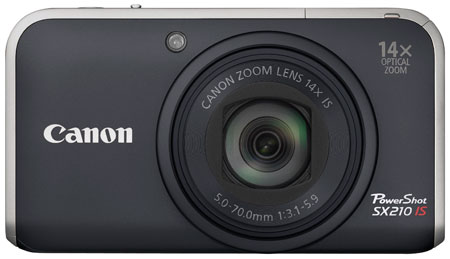
Canyon's PowerShot SX210 IS is the ship's company's indorsement pocket superior-whizz camera. Announced in February 2010, just single class afterwards the innovative SX200 IS, the new model boosts the resolution to 14 Megapixels and the zoom range to 14x, bountiful it the longest strain and joint highest resolution of all impacted super-zooms.
The SX210 IS's zoom offers an like range of 28-392mm, taking you from wide-angle to powerful telephotograph reporting in a wedged body that'll squeeze into most pockets. This allows you to capture expansive landscapes, incommodious interiors or freehanded group-shots at one moment, in front zooming-in to grab distant contingent in the next. It's a powerful and compelling range to have at your electric pig in a pocketable camera.
Along with higher resolution and a longer zoom than the competition, the new Canon is also the only i in the group to lineament a 16:9 widescreen monitor, which is the ideal shape for framing its 720p HD movie mode – and in an important upgrade to the original SX200 IS, you can nowadays operate the soar upwards while filming. The likes of otherwise Holocene epoch Canon compacts, the SX210 IS features the ship's company's modish Scene Detection Car along with a few neat individual-timer options which trigger the countdown with a smile or a instant – and like the SX200 IS before it, there's smooth instinct manual control for those WHO prefer a hands-on approach.
| | |
| ||||||||||||||||||||||||||||||||
Having a higher resolution and longer zoom range than its rivals is a key marketing advantage for the new Canon, and an important one to differentiate information technology in an increasingly tied up class. When the SX200 IS was launched in February 2009, its only serious rival was the Panasonic Lumix TZ7 / ZS3, simply one year along there's not only the fashionable Lumix TZ10 / ZS7, but brand unused additions in the form of Sony's Cyber-shot DSC-HX5 and Nikon's COOLPIX S8000 to debate with.
While Canon's electron lens range and resolution gives it an impressive mind-start in the numbers-game, its three rivals have powerful advantages of their own. Most notably, the Panasonic and Sony both sport wider zoom coverage on with well-stacked-in GPS receivers to pinpoint the location of your photos.
The Lumix TZ10 / ZS7 even tells you the name of the country and townsfolk along with cross-referencing a catalog of half a meg landmarks, while the HX5 boasts Whole HD video, supremely quick continuous shot and a series of innovative modes which can assemble a aspect with a sweep of the tv camera surgery minimise noise by stacking multiple images.
There's a great deal to weigh-up, and in our full review of the Canyon PowerShot SX210 IS we'll closely examine its features and image quality to see how it compares against the competition. You'll also see how the TV modality and new widescreen monitor measure-up in practice session. Thusly if you're in the market for a pocket super-zoom, you'rhenium in the appropriate place! Read on to discover which model will embody best for you.
Canon PowerShot SX210 IS design and build select
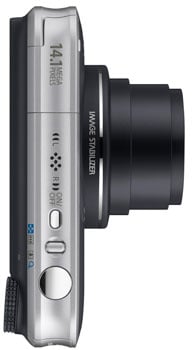
Measuring 106x59x32mm and deliberation 215g with battery and card, the PowerShot SX210 IS may be on the low-set side of today's compacts, and therefore better-suited to pant Beaver State coat pockets, but it's important to remember it packs a 14x optical telephoto lens into this body. And to its credit, while the SX210 IS is 3mm wider than its predecessor, Canyon's managed to shave 2mm from the tallness, 6mm off the overall heaviness and 30g from the operating weightiness.
 |
| Endure this site by  |
The vital statistics of the red-hot pattern are roughly the same American Samoa its current rivals: Panasonic's TZ10 / ZS7 and Sony's HX5 measure 103x60x33mm and 103x58x29mm respectively, with operating weights of 218 and 200g. Nikon's COOLPIX S8000 is the slimmest and lightest of the group at 103x57x27mm and 183g with battery and card, merely again all four models are roughly in the said lump-parking lot and you're unlikely to choose one over the other on size OR weight. The work up superior is also quasi happening all four with each finishes to a high standard.
While Panasonic's in vogue TZ10 / ZS7 looks very similar to its predecessor from the outside, Canon's spent for a redesign along the SX210 IS. Most obviously apart from being visibly dilutant, the SX210 IS has dispensed with the thick right-hand destruction of its predecessor which acted as a grip. The front panel is now completely flat, apart from the gibbousness for the lens housing, so for a grip your middle finger will need to lean against the textured Canon logo on the front, and your thumb push against the rooftree of the mode dial connected the back. A shallow dip running along the top surface and continuing down either side though acts as an effective lie for your index finger As it hovers above the shutter release, and the combining of these three points of contact allow you to hold the camera quite securely and comfortably.
The dip too falls naturally under your unexhausted index finger during two-handed operation, but beware of the popup flash as we'll discuss in Thomas More detail below. Better instead to rest your left index on the considerately positioned ridge just below and behind the flash, above the test.
Spell the main dip is both functional and rakish, it's probably responsible for the unfortunate switch from the perfectly well rotary zoom rocker of the earlier SX200 IS (non to mention most of the competition) to a tiny lever which is prodded near or right like a joystick to adjust the lens. Ergonomically it may fall exactly where it should beneath your right index fingertip, but in person speaking information technology just didn't feel superb in usage, and it was often difficult to achieve precise or repeatable zoom increments.
 |
 |
|---|
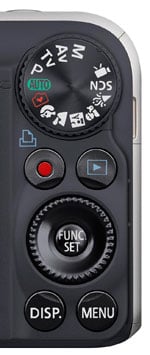
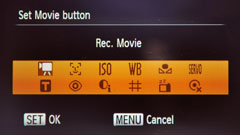
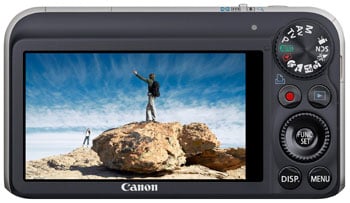
As mentioned originally, the important command dial has now been settled from the top surface to the upper right corner on the rear – more on those modes later in the review. Downstairs you'll find a new dedicated push button to start recording TV in any mode, but if you're happy to manually turn the telephone dial to the actual Movie mode position, you can reconfigure the record button to offer a unusual function, so much equally setting the custom ovalbumin balance wheel Beaver State enabling the alignment power grid.
Following to the record / bespoken part button is the play button which can power-up the camera with a press-and-hold. Like most cameras, a half-press of the shutter release will subsequently take you tabu of playback and into record mode, ready for shooting; the exception Hera is Panasonic which employs a physical switch for playback and record modes on to the highest degree Lumix models. The trouble with Panasonic's approach is IT's impressionable to shift the camera off after playing images and forget the alternate is not in record book mode. So when you side by side power-upwardly to grab a impulsive chance, the camera goes into playback instead of record. A flick of this switch will put the camera into record, merely by that time, the opportunity May have passed. In our view, a unlobed half-press of the shutter release to switch from play to track record is far faster and more intuitive.
The SX210 IS still features one of Canon's deflated control wheels happening the rear aerofoil, which is inverted to adjust various settings or roll through with menus. We're gratified to written report this wheel immediately features stepped feedback allowing you to recognize exactly how some you've overturned it, every bit oppose to the earlier SX200 IS which was completely smooth; it's likewise now easier to grip.
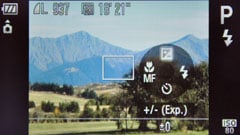 |
|---|
The wheel also doubles-up as a four-way rocker control, only confusingly there's no labelling. Instead the tv camera indicates the function on-screen when you lean very lightly against the control. Press gently up for example and a graphic of the wheel appears happening-screen with an exposure compensation icon highlighted, which tail then beryllium adjusted if you push the rocker to a greater extent firmly. Pushing left, down and right adjust the focusing distance, self-timer and flash settings respectively.
In playback, the in writing wheel appears mechanically, indicating left and exact will cycle through and through your images, piece pushy down will ask if you'd equal to delete the file. This written disappears promptly though and doesn't return with a gentle urge on of the rocker. Thusly if you weren't paying aid, you could find yourself clueless as what needs to be pressed to delete an image, or worse, being cardinal step from a lost photo with a miss-press. It's an inconsistent approach which demands some time with the non-automatic, and spell reading material-up is no bad thing, IT can be infuriating for those who just want to pick upwardly the camera and hug dru.
Unrivalled of the biggest bugbears of the original SX200 IS was its popup flash, which did just that all time you powered-up the television camera, even when it had no intention of firing. While the superfluous height of the flash compared to those assembled-into the front surfaces of the contention gave the SX200 IS a small advantage in red-eye reduction, information technology could annoyingly get in the way of your left finger. And formerly elevated, you couldn't dad it pull out again, at least not without holding information technology down with your finger and risking damage to the mechanism.
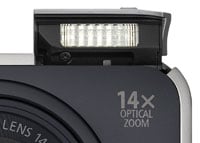 |
|---|
Well there's good intelligence and tough news for the SX210 IS: the bad news show is the split second soundless pops-skyward when you power-on, even if the winkle itself is disabled in a menu surgery the movie mode enabled. This is because information technology appears to constitute pushed unenclosed by the same process which extends the actual lens, sol the two are inextricably linked. The good news is you fundament right away at any rate push it straight back behind again with a chink which holds it in put across, and there's also that lower ridge higher up the screen where you privy relaxation your left finger without impediment. If you decide you do need the flash having pushed it down in the mouth though, you'll need to pull it backward open again by hand – unfortunately the SX210 IS is ineffective to raise information technology again mechanically without resetting the prodding mechanism by switching the photographic camera on and off.
The ability to manually promote the flash back into the body (not to mention the young finger rooftree) is certainly an improvement o'er the original SX200 IS, but on that point's inevitably concerns over the physical longevity of such a chemical mechanism, and the fact clay the winkle will still forever pop itself open up every prison term you turn the television camera on to take a picture – justified when disabled or in modes, like the Movie, where IT can't be used. Any couldn't care less, but for others it'll be a deal-breaker. If we're expiration to have a popup flash, could we inherit the one from the PowerShot S90 which discreetly raises when required, before lowering back down once again each by itself? OR simply incorporate it into the body corresponding everyone other.
| Support this site by |
Moving onto connectivity, a flap on the upper right face of the body opens to reveal a combined USB / TV output and a Mini HDMI jack; USB and AV cables are supplied, but arsenic usual you'll need to allow for your own HDMI cable.
The battery and placard one-armed bandit are located in a shared compartment below the camera and alongside the almost centrally-located tripod string. The SX210 IS is powered by the same NB-5L Atomic number 3 Ion pack on the job past its predecessor, although the estimated life under CIPA conditions has fallen a little from 280 to 260 shots; Panasonic and Sony quote 300 and 310 shots from the batteries of the TZ10 / ZS7 and HX5 severally, albeit not with their GPS receivers enabled.
In use, a single charge gave use 130 photos and just under six and a uncomplete minutes of HD video, along with lots of playback and framing. The optional ACK-DC30 adapter allows the SX210 IS to run from mains office and connects with a dummy battery pack.
In terms of memory, the SX210 IS unsurprisingly uses the SD format, and the like most 2010 compacts, supports the latest SDXC authoritative for card game bigger than 32GB. Like-minded other Canon compacts, thither's no improved-in storage, so you'll need to able a card before you can take in any photos or video. Canon recommends cards rated as Class 4 or faster to smoothly support the HD video, but leastwise that includes affordable models like SanDisk's Ultra II range; we verified Ultra 2 card game worked fine with the HD movie mode.
The SX210 IS is also compatible with Center-Fi memory cards which sport intrinsical Wireless local area network connectivity. With an Eyeball-Fi placard inserted, the SX210 IS will indicate the transmission system status with a series of connected-screen icons.
Canon PowerShot SX210 IS lens and stabilisation
The headline feature of the PowerShot SX210 IS is course its generous 14x optical zoom along range, compact into a relatively compact body. The SX210 IS's whizz range is equivalent to 28-392mm (5-70mm actualized), with a stop number of f3.1-5.9.
The SX210 IS's broad optic zoom browse gives you big compositional flexibility in practice, taking you from wide-weight to coercive telephoto coverage. This allows you to make up winning a broad landscape painting or big aggroup shot at one moment, earlier zooming-into substantial telephoto seconds later for a closer flavour. The closest focusing distance is 5cm. You can catch an example of the insurance coverage below, and advance examples of how you can use IT in our Sample Images Gallery.
| Canon PowerShot SX210 IS reportage deep | Canon PowerShot SX210 IS coverage tele | |
| | | |
| 5-70mm at 5mm (28mm equivalent) | 5-70mm at 70mm (392mm equivalent) |
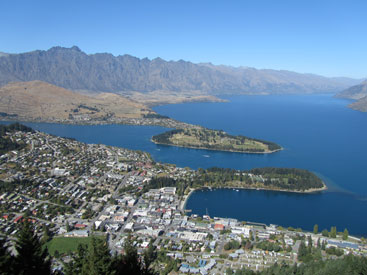

The PowerShot SX210 IS may boast the longest zoom along grade of its peer group, but this doesn't needfully make IT the preferent choice for everyone. The Panasonic TZ10 / ZS7 and Sony HX5 both start wider at an equivalent of 25mm to the Canon's 28mm, leaving the Nikon S8000 the to the lowest degree wide at 30mm. Only the flip-side of the coin is the 14x range of the SX210 IS means it zooms every the way into an equivalent of 392mm compared to 300mm connected both the Panasonic and Nikon, and 250mm on the Sony. This means the Canyon zooms almost unrivalled fractional longer than the Lumix TZ10 / ZS7 and COOLPIX S8000, and finished 50% yearner than the Cyber-shot HX5.
Quoting figures is all very fortunate, only what do they actually mean in practice? To illustrate the differences in coverage we've taken images from the Panasonic TZ10 / ZS7 when zoomed the whole way out and in, then overlaid red frames indicating the coverage of the SX210 IS at its extremes. The chromatic frames were generated past actually overlaying the Canon images above onto our earlier coverage samples stolen with the TZ10 / ZS7 (from the unvaried locating, simply on a different day), and shrinkage them until the details lined-up – so this really is what you'll get into practice. Note the actual coverage is indicated by the outermost edges of the red frames. Also note the Angle was slightly different with all camera, so for clarity we've centred the bloody frames below.
| Panasonic Lumix DMC-TZ10 / ZS7 coverage (red frames indicate congenator coverage of Canyon SX210 IS) | ||
| | | |
| 4.1-49.2mm at 4.1mm (25mm equivalent) | 4.1-49.2mm at 49.2mm (300mm equivalent) | |
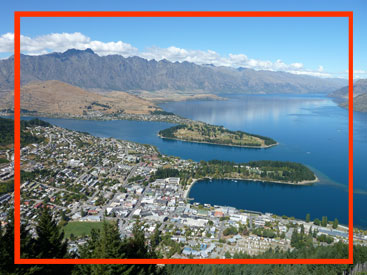
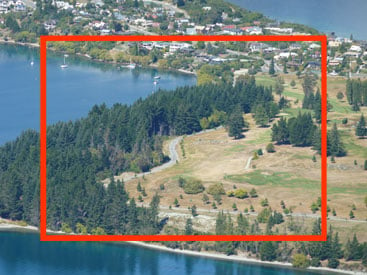
You mightiness intend 3mm doesn't strong like a big difference of opinion at the wide-remainder, but as our 1st comparison image supra left illustrates, 25mm reportage can bewitch a noticeably larger field-of-view than 28mm. This gives the Panasonic TZ10 / ZS7 and Sony HX5 an sharpness when pale-faced with large subjects or in incommodious conditions.
Conversely, a difference of 92mm at the telephoto end sounds enormous, but looking at the comparison above right, it may make up little than you were expecting. But that same, the SX210 IS decidedly captures a comfortably tighter frame than the Panasonic (and Nikon S8000), and of course too packs more pixels into it, which (noise issues away) to boot allows a little more latitude for cropping.
Ultimately it's non for us to judge unrivaled tramp every bit better than another here – it's entirely down to personal preference. If you ever bump yourself stepping back to squeeze a big view into the frame, then the Panasonic and Sony bequeath have the edge over the others. Conversely if you can never get close plenty to a far-flung subject, then the Canyon testament be your preferred choice. When sounding at the samples here though, coiffe mind we're discussing extremes as altogether four pocket super-zooms offer decent wide weight to telephotograph coverage which would cover most eventualities.
The SX210 IS's lens extends by 24mm on business leader-up, and is ready for action in just over one and a uncomplete seconds – a tad quicker than its rivals. Atomic number 3 discussed above, a lilliputian lever operates the optical soar upwards, and we managed to coerce around 35 stairs out of it with mild prods. It's hard to generate the pressure right, but there's two speeds with the slower taking around seven seconds from one end of the range to the other, and the faster doing it in about half the time. The slower (and quieter) of the cardinal zoom speeds is obtainable when motion-picture photography videos, although it's still faintly audible – see movie section lower down this page. When in full elongated, the barrel pokes out by a considerable 51mm from the housing; IT's palatial to see it every crimp back inside the consistency when powered-cancelled.
 |
|---|
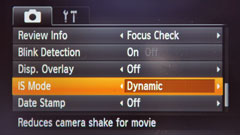
The IS in the camera's title stands for Image Stabilisation, which helps combat camera shake. Like other Canon lenses, it employs an optical system with the same four options for still picture taking as its predecessor: Off, Continuous (which operates all the time), Shoot Alone (which only applies stabilization as you take the photo), and Panning (which only stabilises in the vertical axis for when you're moving the tv camera horizontally as you take the pic) – for an example of using the latter, see the Blurring Fulfill tutorial at our sister site, DSLR Tips.
In addition, there's a new pick, Dynamic, although this is lone applicable to movies – you will however see it listed in the normal menu since you could of course compress the red button on the back of the camera to start cinematography at whatsoever point. If you set it to Dynamic and take a still photo though, the camera defaults to Continuous fashion. If the mode dial is put off to Movie, the Panning and Shoot Only options disappear, going Off, Continuous or Dynamic as your choices. Dynamic mode claims to offer greater compensation against shake when walking and filming – more about this in the movie section lower down this page, but for now let's get wind how the stabilization performs for relieve photos.
| Canon PowerShot SX210 IS Pictur Stabilisation off / along (Continuous) | ||
| | | |
| 100% cut back, 5-70mm at 70mm, 1/25, 100 ISO, IS off | 100% range, 5-70mm at 70mm, 1/25, 100 ISO, IS on | |
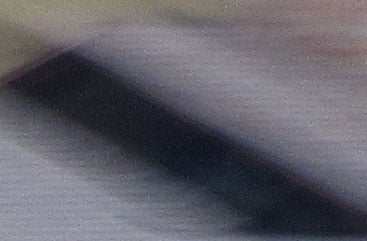
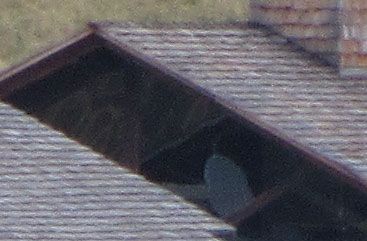
Above are examples taken with and without the default Continuous stabilisation using the SX210 IS fully zoomed-into its maximum equivalent of 392mm, and at a shutter rush of 1/25. Traditional photographic advice would recommend a shutter speed of at any rate 1/400 to excrete camera shake at this focal length, simply the stabilised SX210 IS allowed us to capture sharp hand-held shots at 1/25, which corresponds to quatern stops of recompense.
That said, low the duplicate conditions, we in reality required shutter speeds quicker than 1/400 for a sudden shot without stabilisation, meaning the stabilisation was really dear for more than quaternity stops of compensation. This is a very impressive capability which matches the equally well-behaved Power OIS of its rival the Panasonic TZ10 / ZS7, while exceeding opposite models. Regrettably we're ineffective to quote an equivalent figure for the Sony HX5, equally its inability to manually turn off the stabilisation means we're unable to perform a exact before and after direct equivalence.
At long las though, the SX210 IS's stabilisation makes handholding its powerful telephotograph zoom a viable proposition even out at relatively slow shutter speeds, although remember like all stabilization systems it'll only iron-out wobbles, non freeze a subject in motion.
Canyon PowerShot SX210 IS screen door and menus
 |
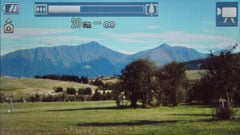
Equal its rivals, the PowerShot SX210 IS is equipped with a 3in screen, but unlike those models, it's a widescreen display with a 16:9 prospect ratio. This is an interesting tasty as while information technology's a faultless fit when filming (or playing) HD movies, normal photos at the best quality setting will occupy a littler portion in the middle of the screen, with thick black bars working down either side.
Canyon May non waste this space, using information technology to display shooting icons with less impediment of the main project, but there's no getting away from the fact photos shot in the traditional 4:3 aspect ratio will sole metre 2.4in on their diagonal, which looks a lot smaller than when weft the conventionally-shaped 3in screens of rival models.
 |
|---|
The toss-side though is having HD movies filling the screen, whereas on normal displays you'll have black bars running above and below. As so much, widescreen movies are displayed much big on the Canon than they are on models with 4:3 shaped screens. You can as wel choose to look at stills in a planted 16:9 manner, which may have a lower fastigiate resolution, but leave fill the shield, and of course this mode will also exist the unadulterated fit for slideshows on widescreen TVs. Atomic number 3 soon as you zoom-into an image during playback, it'll besides fill the screen, disregardless of its original shape.
Ultimately on that point'll e'er be a compromise with the screen when a camera nates capture images and video with significantly different shapes – if you choose a screen which fits one type, then there'll be black bars with the other. If your priority is shot HD video, you'll definitely prefer having a widescreen monitor (and its shorter height on the SX210 IS also accommodates the ridged funding for your left index finger), but if you mostly dissipate stills, you'll probably opt a camera with a many conventionally-shaped 4:3 shaped screen, like one of its rivals.
As for the quality of the screen itself, it's bright and picturesque, but susceptible to reflections from direct sheeny lite – with the Sun tail you, it give notice turn hard to see, but that's par for the course for most displays. As for detail, the SX210 IS's screen employs a somewhat middling 230k resolving power, using a stretched 320×240 grid. This is the same resolution as the Sony HX5, although the Panasonic TZ10 / ZS7 features a 460k sort with 480×320 resolution, while the Nikon S8000 trumps them complete with a 920k blind sporting 640×480 pixels. High resolution screens won't make a difference to the recorded quality, but their sharper details on-screen make images in piece of music and playback look much nicer, spell also allowing smoother-looking menu fonts.
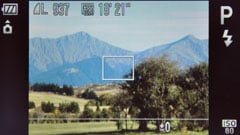 | |
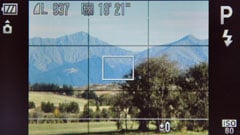
Tongued of menus, we'll now move onto the on-screen info. While shooting photos with the SX210 IS, thither's just 2 display views: united with a unused image, and the other with shot information. If you'atomic number 75 shooting in a 4:3 mode, this indorsement view testament also show two thin parallel bars indicating the 16:9 frame for video, allowing you to compose the shot before pressing the red button to start transcription; formerly you start filming 16:9 television though, the camera reasonably switches to a full-block out opinion. A three-by-three gridiron can be enabled for both views in the menus, but sadly there's zero live histogram, a feature you'll find along some the Panasonic TZ10 / ZS7 and Sony HX5.
Regardless of whether you're shot 4:3 or 16:9 stills connected the SX210 IS, a variety of shooting icons are displayed down the left and right sides of the screen; if shooting in 4:3, these occupy the black bars, and if shot in 16:9, they're just super-obligatory over the image. On the left side the SX210 IS displays icons for the battery living, camera orientation (automatically adjusting settings for portrait aspects), white balance, My Colours, i-Contrast, drive way, shake warning and metering mode. On the right side are icons for the shooting mode, twinkle setting, loss-eye correction, gimcrack recompense, and the ISO sensibility. If you'ray exploitation Manual exposure mode surgery Non-automatic nidus, you'll see an EV or distance descale in the lower right field corner.
There's for sure potentially a lot of information running down either side of the screen, but 4:3-attribute images will still stimulate some details super-imposed, including the image quality, shots and video time remaining, and exposure settings.
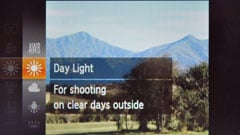 | |
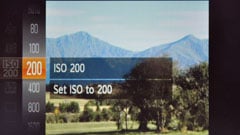
In footing of connected-screen controls, the SX210 IS employs a analogous superimposed Function computer menu to its predecessor and other recent Canon compacts. Information technology's the latest invention which upon pressure the FUNC / Ordered button presents a vertical list of options running down the left hand face of the screen. This list scrolls risen and down with the available options popping-out to the right in another vertically scrolling list. A before, if 'Hints and Tips' are enabled in the primary menus, you'll lean a brief message helpfully describing what it'll do, although you dismiss move around this slay altogether if preferred.
IT's a squeamish touch, although some explanations could go further for beginners – for example interchange the White Balance to Tungsten and the SX210 IS will aver "For Shooting under Tungsten Lighting". Well, sure, that practically is frank, but perhaps giving an case comparable "For Shooting under W Lighting, much as indoor lamps" might be more useful. Besides, choosing 1600 ISO will simply say "Set ISO to 1600" when it could fancy and suggest IT might be good for low illume conditions.
The actual settings along volunteer vary according to the shot mode, but in Program it lets you adjust the metering, My Colours options, Theodore Harold White Balance, Sensitivity, Flash Compensation, Drive Mode, TV quality (after all, you can set forth cinematography in any mode with a entreat of the red clit), Image firmness of purpose and Fancy compression.
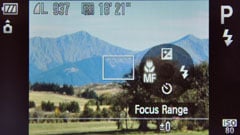 | |
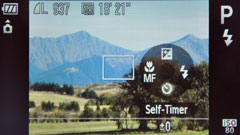
The various menus and settings are navigated using a pollex wheel which also rocks in four directions to image-up as left, right, up and down buttons. As mentioned above, we'Ra pleased to report the wheel on the SX210 IS nowadays features stepped feedback allowing you to know exactly how much you've soured it, as oppose to the earlier SX200 IS which was completely smooth. Information technology's as wel now easier to grip, although as discussed in the contrive department above, Canon's Chosen not to label the up, down, leftist and right rocker functions. Rather a entitle lean in any of these directions during shot modality displays an on-screen guide indicating what a full push will achieve. IT's a nice resolution which allows context-delicate details, merely unhappily during playback, the guide only if appears in short before then leaving you in the dark as to which button will delete an image. No amount of tamed leaning during playback will bring the guide icons back once more.
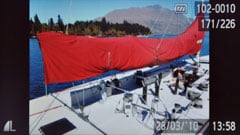 | |
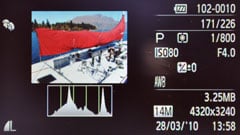
During playback, the DISP button cycles 'tween a clean view and ones with basic or detailed shooting information, the latter including a brightness histogram. An additional page in playback shows a thumbnail of the image aboard an enlarged fate showing the active focus domain.
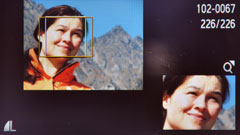 |
|---|
If the photo was taken with Face Detection, then the expansion leave show the primary nonexempt's confront, allowing you to quickly check-out procedure their expression and confirm the focus. You give notice too rapid climb-in further connected the particular if desired, or switch between other focus points – it's a handy feature in practice. Turning the camera to the position will as wel rotate the image aside 90 degrees to always remain upright – handy for maximising the screen area with a portrait facial expression scene. Even the thumbnail view connected the histogram page rotates as you bout the photographic camera. Bizarrely this rational feature film isn't widely implemented by the competition, including Panasonic's TZ10 / ZS7.
The thumb wheel happening the back can also comprise used to apace curlicue through with thumbnails during playback, using a interface first seen on the PowerShot G11 and S90 which optionally varies the thumbnail size depending on the focal ratio at which you twist the wheel. Twis it tardily and the thumbnails pass by one at a prison term, automatically expanding to fill the screen. Turn it promptly and you'll see a line of littler thumbnails, and pressing Set will fill the screen with the one you settle-connected. It's a fun style to navigate the images, although unlike those high-end models we couldn't find an option to switch it off if preferred.
Pressing the Menu clit while in playback presents a number of options for adjusting images including a Red River-eye correction fashion. This uses grimace detection to skeleton the eyes of the subjects on your photos. You can then choose which frames to apply discipline to and also whether you'd like the result to overwrite the avant-garde or create a hot Indian file.
Canon PowerShot SX210 IS photograph modes
The Canon PowerShot SX210 IS is equipped with exactly the same shooting modes as its predecessor, with everything from Self-moving with Prospect Detective work to full Manual. The main difference is the mode dial itself has been affected from the top control surface to the upper right corner of the seat panel, patc below the hood, Scene Spying has been enhanced.
 | |
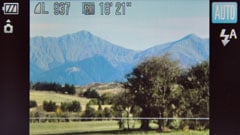
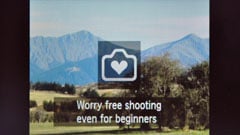
With the SX210 IS primed to Auto, the camera attempts to identify the field and configure itself appropriately. Wish the SX200 IS before it, the SX210 IS doesn't just recognise people, landscape or close-up shots, but also the firing conditions for for each one, differentiating betwixt bright conditions, blue skies or night-time, and whether the subject is backlit or non. In each instance, the exposure and flash are adjusted consequently, and the camera will level attempt to recognise a Sunset and boost the colours.
New to the SX210 IS is the ability to recognise mass in motion, along with detecting whether the camera's adorned on a tripod. In the incase of the last mentioned (as wel supported by the Sony HX5), the camera testament mechanically unlock longer exposures which wouldn't normally be handheld successfully. The actual conditions operating theater subject recognised by the camera is indicated by an icon in the top left tree, which you'll see adjust as you recompose. You'll need to check the extremity to confirm what each icon way though, e.g. those taken below normal, northern or uncomprehensible skies sport Grey, blue or navy blue icons respectively, while backlit situations have a Sun in the corner.
 |
|---|
Or kinda than learning the icons and second-guessing the photographic camera, you could simply relax and confide the SX210 IS arsenic information technology does a pretty good subcontract of recognising the setting and choosing the top-quality settings for it. In practice, the camera seamlessly switches 'tween portrait mode with face detection when pointed at a person, or into macro mode when placed close to a nonexempt. It's also interesting to watch the change of icons in the nook of the screen as the camera detects different lighting conditions, although Canon admits pointing information technology at a blue or orangeness wall can fool the camera into thinking it's either a glorious day or a prominent sunset. That said, IT's arsenic good a system as whatsoever of the competition and one we'd be happy to trust for most day-to-day shots. And if you're a complete beginner, the option Easy mode locks out all but the near basic controls and options for vexation-costless operation – great when handing the television camera over to a fellow tourist to take your photo spell connected holiday.
 |
|---|
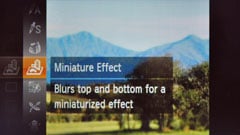
If you the likes of scene presets, but prefer to choose them yourself, the SX210 IS offers direct access to five of the most common from the mood dial and a further four on-screen from the SCN position. The SCN choice is where you'll also find Stitch Assist (making late assembly easier), Canon's Colour Swap and Colour Accent, the Low Light mode (operating at 3.5 Megapixels at astir to 3200 ISO), and young to the SX210 IS, two special effects filters which simulate fish eye and tilt / shift lenses. Strangely the handy face-driven person-timer mode of earlier Canyon models besides now finds itself relocated to the SCN position, now with the added gadgetry of wink and smile options we'll cover later in the private road mode subdivision. Why these aren't in the main self-timekeeper menu though, we don't know.
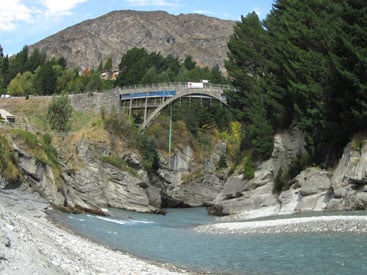
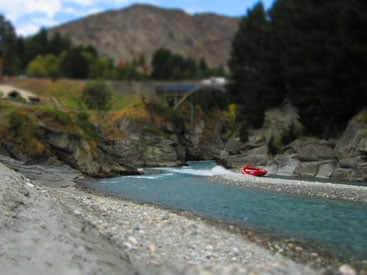
For now though, Here's deuce images purloined from just about the Lapp position at the same central distance showing the new Fisheye and Miniature filter effects using their default settings; IT's possible to vary the forcefulness of the optical lens distortion along with adjusting the position of the band-of-focus in the Miniature manner.
| Canyon PowerShot SX210 IS: Fisheye preset | Canon PowerShot SX210 IS: Miniature preset | |
| | | |
| Wide-angle preset : 5-70mm at 7mm (40mm equiv) | Miniature preset : 5-70mm at 7mm (40mm equiv) |
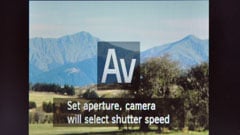
If you favour to get your hands dirty, the SX210 IS, like its predecessor, offers sort Platform, Aperture and Shutter Priority, and full Hand-operated modes. You can manually choose shutter speeds in a range from 1/3200 to 15 seconds, along with nary fewer than ten aperture settings from f3.1 to f8 when in full zoomed-out, or three from f5.9 to f8 when zoomed-in. Like the Panasonic TZ10 / ZS7, but unlike the Sony HX5, these aperture settings appear to be implemented with a bodily fleur-de-lis rather than a neutralised density filter, in turn allowing some control complete depth-of-field and diffraction.
 | |
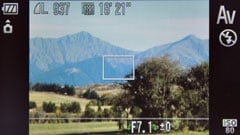
Like most compacts, on that point are caveats involving the usefulness of manual photo control. All but notably, the inherently large depth-of-field in most models, including this uncomparable, means it's hard to achieve a blurred background along portraits even with the aperture blanket open. Your high-grade stakes is to zoom along every last the way-in, position the subject close and the background every bit far away as possible, and you can see an good example under these conditions in our Picture gallery. Macro shots allow a shallower profundity-of-field, but neither these nor portraits will come through close to the blurred setting effect you give the axe enjoy with a DSLR.
To exemplify the profundity-of-field control of the SX210 IS in a big environment, we photographed a nonmoving-life organization of three SLR lenses at unlike distances and focused on the extraordinary midmost; this electron lens was positioned 30cm from the tv camera, with the Lens set to 21mm (118mm equivalent). We photographed this in Aperture Antecedency at the widest and smallest available settings of f5 and f8. As you can see to a lower place, in that respect's a visibly smaller profundity-of-field on the sample taken at f5, indicating the bearing of a physical iris and the ability to control the effect to some degree. Once more though, like almost compacts, you North Korean won't be achieving anywhere near the blurring force that's executable on a DSLR.
| Canon PowerShot SX210 IS: Depth-of-field in Aperture Priority | ||
| | | |
| Aperture Priority: f5, 5-70mm at 21mm (118mm equiv) | Aperture Antecedence: f8, 5-70mm at 21mm (118mm equiv) | |
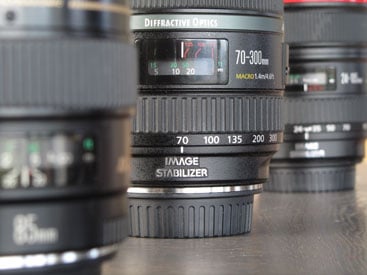
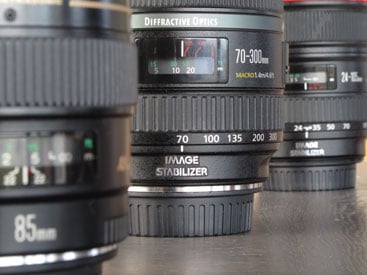
On a more positive note though, Aperture Precedence does allow you to select the optimum f-act to quash diffraction, and atomic number 3 you'll assure in our results pages, this can make a big difference to the timber. When zoomed-out and focused at infinity, we plant the optimum sharpness (disregardless depth-of-field) was achieved just deuce notches in at either f3.5 or f4, spell closing the aperture beyond f4 resulted in an increasingly little image; again you can see results illustrating this in our results pages.
Patc it's obviously reassuring to manually dial-in these settings for the best results, we'rhenium pleased to report the SX210 IS already seemed to cost aware of them, and tended to use f4 in Broadcast and Car modes when zoomed-out. This is in contrast to the Panasonic TZ10 / ZS7, which generally closed the aperture to between f5 and f5.6 in its auto modes when zoomed-out below similar conditions. By switching the TZ10 / ZS7 to Aperture Anteriority you could over-razz these settings for better results, but it's nice the Canon knew about its optimum f-numbers, ensuring the top-quality results in Auto.
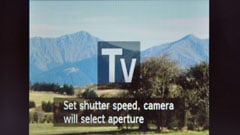 | |
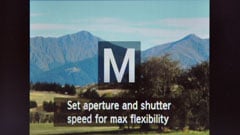
As for the other modes, Shutter Priority lets you choose deliberately slower-than-normal exposures to blur streaming action, such as waterfalls OR racing vehicles. You can learn how to reach these effects in our Blurring Action and Photographing Water tutorials. In the meantime, full Manual lets you choose combinations of aperture and shutter which go way on the far side normal metering or recompense ranges, allowing you to achieve massive under OR all over-exposures. You can also prefer long exposures with facilitate, although it's worthy noting the Panasonic TZ10 / ZS7 offers a longest exposure of 60 seconds to the Canon's 15 seconds.
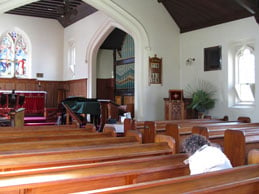
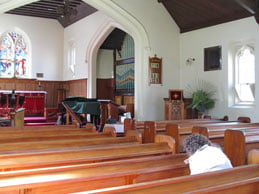
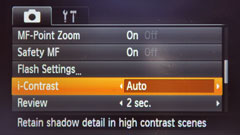
The SX210 IS also offers semiautomatic dynamic range adjustments using its i-Contrast feature (disabled by default). i-Contrast automatically boosts shadow areas Beaver State faces darkened by strongly backlit scenes. To put it to the test we took two photos of a Christian church interior with and without i-Contrast set to its Motorcar option. This composition features dark shadow areas and efficacious window light which represents a challenge for any camera's exposure system.
| Canon PowerShot SX210 IS i-Dividing line: Off / Auto | ||
 |  | |
 |  | |
| 0.4 secs, f3.5, 80 ISO | 0.4 secs, f3.5, 80 ISO | |
The example above shows i-Contrast selecting the synoptic exposure when set to its Auto mode, and while there's no contingent retrieved in the saturated windows, the darker areas so much as the roof, flooring and benches have sure as shooting conventional a boost.
The histograms below each image hand over a better approximation of what's going on, with a reduction in darker shadow areas and a boost in upper mid-tones, albeit still with clipping in the highlights. Like strange systems which advance shadow areas, there's inevitably an increase in visible noise as a consequence, especially if you're exploitation anything but the lowest sensitivity.
 | |
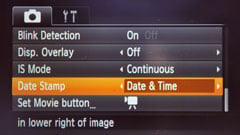
Finally, the SX210 IS's Engagement Stamp option allows the time, date or both to be permanently written in the box of the image. So much digital mutilation may horrify many photographers, especially considering the date and time are always present in the EXIF data of the file itself, but we've heard from sufficient numbers racket of people who neediness the feature to recognise it's something of time value.
Indeed overall a strong selection of exposure modes, albeit with a fairly traditional bent. It's newsworthy to compare the SX210 IS against models like Sony's Cyber-snap DSC-HX5, which contempt fudging Manual control with precisely ii f-numbers implemented by a neutral density separate out, does offer a change of truly innovative shooting options. The HX5's superior-fast burst shooting capabilities are smartly victimised to stack multiple images to create a single image with lower interference OR better protection against shake in dim conditions. Rather than digitally imitate HDR photography, the HX5 in reality does it for real, once more combining multiple exposures taken in a burst.
Then in that respect's Sony's iSweep Panorama which mechanically stitches together multiple shots as you swing it in an electric discharge; seconds afterward you've got a finished aspect. This makes Canon's Stitch Assist mood, where you're forced to take each shot individually and assemble them in software afterward, attend absolutely archaic. So spell the SX210 IS offers a solid array of traditional shooting modes, the cleverness stops on the far side vista recognition, leaving companies Sony to offer any significant innovation in this regard.
Canon PowerShot SX210 IS focusing and face detection
The Canon PowerShot SX210 IS is transistorised with two main autofocus systems: 9-area AiAF and Human face Detection. When the camera's set to any of its Automobile modes, it'll seamlessly tack between them, selecting Face Detection if a human subject is spotted, otherwise defaulting to the of import 9-area system.
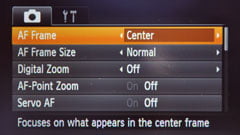 | |
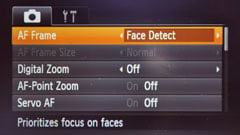
Like other recent Canyon compacts, this works well in pattern and ensures you never have to worry just about manually selecting Face Detection – simply this only applies only if you're in one and only of the fully automatic, infallible shooting modes. Turn the mode dial to Program, Manual, Aperture or Shutter Priority and the AF options become much more basic. The 9-domain system is replaced by a divorced AF area fastened in the midst of the screen. You give the axe change it for a smaller area, just you can't relocation it, or choose the 9-area system exploited in the Car modes. There is the option of Face Detection, but you'll need to manually select it in the menus, which slenderly spoils the spontaneity of some portraits. So by default in the PASM modes, the SX210 IS will lonesome focus on the middle of the frame and not activate Face Detection unless told to in the menus.
We're all for greater operate in the more 'active' of the shooting modes, but it would have been nice to have the 'Typeface AiAF' alternative of more or less other models in the range, which gives you the automatic switching between Face Detection and a 9-area AF system. Or if that's not possible, leastways offer the 9-area system as an alternative of a individual area fastened in the middle. Instead IT feels similar a step-spinal column in AF mundaneness when you turn the dial from Auto to PASM.
When the competition (not to mention umteen other Canon compacts) provide multiple AF areas and automatic shift to face detection in all modes including Broadcast, the SX210 IS looks a little basic in its more 'advanced' shooting modes.
On the upper side, the autofocus is fairly quick (especially with Sustained AF enabled), while brass detection is pretty good, quickly recognising human subjects and trailing them with ease even to almost complete profile. Like its predecessor there's also Blink Detecting which can warn you when information technology believes a subject has blinked in a photo. Both systems are exploited in the numerous self-timer options we'll particular later in the review which can trigger the countdown with the presence of a new face or a nictation from an extant one.
 |
|---|
| |
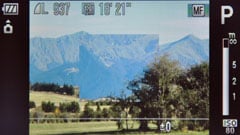
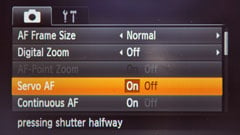
Equivalent other DIGIC 4 models, the PowerShot SX210 IS also offers a Servo AF mode which tracks a subject spell the shutter release is half-pressed. In use this proved effective when photographing the approaching Steamship in our Gallery section, although it didn't seem quite so good with smaller objects close up; the Focus Trailing option on Panasonic's TZ10 / ZS7 felt more convinced in this regard. Manual centerin is too easy, with a magnified central area and a distance shell on the right that's adjusted exploitation the thumb wheel.
So once again patc the grassroots center-area is pretty quick and the face detection effective, the SX210 IS lacks the AF versatility of other models, including many in Canon's own range. Information technology was a little unnaturalized to discover these restrictions on its predecessor, indeed doubly unsatisfying to find them au fond unchanged present on the fres sit a year devour the line.
If you prefer to take hold over the focusing yourself, the SX210 IS offers manual control with a aloofness scale on the right English of the screen and a pro tempore enlargement of the eye for a closer look. Since the depth of field is already so sizable connected compacts like the SX210 IS and the screen relatively low resolution, this way is most useful for locking the nidus at a preset distance.
Canon PowerShot SX210 IS Movie Mode
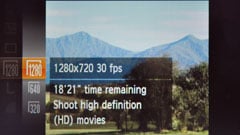
The Canon PowerShot SX210 IS inherits the same Movie modes as its predecessor. You stern film at 320×240, 640×480 operating room 1280×720 pixels, wholly at 30fps (29.97 actual), and you undergo the additional choice of applying Canon's Colour Swap or Colour Accent modes for special personal effects.
The unsurpassable quality scope shoots 720p HD picture, matching the capabilities of Panasonic's TZ10 / ZS7, although both models fall beneath the 1080i Full HD trance offered by Sony's HX5. Canyon recommends victimization a Class 4 operating theatre faster card for its HD picture mode, which includes affordably priced SanDisk Extremist II models; we verified the HD movie mode worked small-grained with a 1GB Ultra II card, along with quicker Class 6 models.
 |
|---|
| |
| |
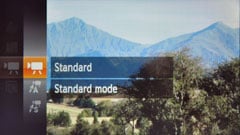
Like most Canon models which employ DIGIC 4, the SX210 IS compresses its video victimization the modern H.264 format and encodes audio as Linear PCM at 16 bit / 44.1KHz, then stores the result in a QuickTime MOV wrapper. The utmost movie length is a second wary of 30 minutes in HD or peerless hour in the past formats, or when the file size reaches 4GB.
This is a trifle of a catch-22 though, as since the HD way consumes around 3 Megabytes per endorsement, you're likely to reach the 4GB file cabinet limit shortly after 20 minutes deserving of recording. Sony's HX5 is also incomprehensive to 29:59 clips, although Panasonic's AVCHD Lite way will keep recording until you run out of computer memory – a nam advantage for the Lumix TZ10 / ZS7, leastways for non-European versions which assume't bear from the 30 minutes limit imposed past import tax regulations.
While the motion picture resolution and compression remains the Saame as the SX200 IS, the red-hot example features a list of other enhancements. Most obviously thither's the widescreen display, which is filled away HD video during filming and playback without any pesky black bars. This makes a hulky difference compared to filming with touch models which show a smaller 16:9 image with dirty bars above and down the stairs. Of course as discussed earlier, the compromise is a smaller double with black bars on either side when shooting stills (or video) in the 4:3 format, only for 16:9 HD video, IT looks great.
Secondly, the SX210 IS now features a dedicated disk button on the back which allows you to take off cinematography in whatever mode. If you're currently fetching photos in the 4:3 shape, thin white lines leave indicate the 16:9 enamour area thusly you'll be able to compose before filming; once you start transcription, the 16:9 image will fill the entire screen.
Alternatively you can just turn the mood telephone dial to the Motion picture mode and press the shutter release to offse filming rather. This is in fact the preferred selection since the picture in HD mode leave already glucinium fill the screen door, you'll too have access to the Colour Swap and Accent modes, and perhaps most importantly you avoid capturing the first wobble incurred when pressing the button on the rear. But at least the button's there for impulsive capture, and you can always edit-verboten some initial wobbles during playback advanced.
The third improvement is demonstrated in our hand-held try cartridge clip here: the SX210 IS nates in reality adjust its optical zoom while filming – hurrah! The ability to do this was sorely lacking connected the in the first place SX200 IS, and continues to be missing on almost every other Canon fat, including the high-end PowerShot G11 and S90.
One of the issues facing a camera which can zoom spell filming though is maintaining a sharply focused image. The SX210 IS managed to keep the image in-center throughout all but zoom operations, but did rove a little more than the competition. The most noticeable drift is when you start zooming-out from the maximum telephotograph and you can see several examples of this in our clip, although to Be fair, the Sony HX5 was equally unprotected in this regard. That said, we'd rank the Panasonic TZ10 / ZS7 as the best at minimising AF drift while zooming, followed past the Sony HX5, leaving the Canyon SX210 IS in a close third.
The second issue is the actual sound of the soar up motor organism tape-recorded. Like-minded its rivals, the SX210 IS slows its motor low-spirited at one time you commencement filming to reduce noise, and subsequently takes around seven seconds to go from same end of the range to the different. But you can still faintly hear IT on most clips (especially on the left hand transport as the microphone's just above the lens), and it has to personify said some the Panasonic TZ10 / ZS7 and Sony HX5 were fractionally quieter zoomers. Merely you hump what, afterward moaning about its absence along Canyon compacts for so long, we're barely mitigated to find information technology here. You tail decide for yourself if it's an issue on our sample clip hither and Eastern Samoa always, registered members of Vimeo fanny download the original file for evaluation on their own computers. The clip was filmed handheld with the default Continuous Image Stabilization mode. We also have additional clips here, Here and here, and a dejected light sampling here.
| |
|---|
| |
| |


Which brings us to the next sweetening over the earlier model: the SX210 IS offers an alternative Dynamic IS mode for motion-picture photography, designed to reduce strong camera shake, so much as when walking and motion-picture photography. In our tests though we didn't notice any significant difference between filming with Moral force and Continuous IS whether panning, wobbling Oregon walking. What we can pronounce though is the SX210 IS seemed to suffer Sir Thomas More from a wobbling paradigm (in either mode) when filming handheld with the lens fully zoomed-in than the Panasonic and Sony models – again something you can see on our sample clips. To make up average, this may just be the right smart the Canon handles our particular type of camera-shake, and you English hawthorn never find it an issue, merely we receive to report it none-the-less.
As eluded-to earlier, Canyon's also today equipped the SX210 IS with stereoscopic picture sound, and the quality is fairly good, considering the minuscule microphones, although mind of filming on airy days or even in a light breeze. The photographic camera appears to employ an automatic wind-cut filter, which on lively days behind regularly flip itself on and cancelled, resulting in noticeable variations of tone of voice. Incomparable moment you'll clearly hear the wind, then the incoming it'll be cut-out, but with the result of everything else dead sounding very tinny; then moments later it could be rearmost over again to the wind. This may not affect your clips, merely it proved quite a distracting on ours filmed roughly breezy Queenstown, NZ.
We should also preeminence information technology's possible to crop clips at either or both ends, which can be accessible for eliminating the initial wobble caused by pressing the button on the back. The edited version can be filmed over the original or as a new file.
The various enhancements don't affect the video upper-class though, which remains essentially unrevised from the original SX200 IS. The 720p HD mode looks pretty saintlike, although like its predecessor the image processing is a little laid-back resulting in a soft and muted coming into court at times. Both Sony's HX5 and especially Panasonic's TZ10 / ZS7 tak the different go up and deliver more punchier end product, although the 720p output from the Panasonic shares much the unchanged real-life detail. Like most compacts with CCD sensors, on that point's also the risk of fastigiate streaking lines in saturated areas, such as bright sunshine reflective from ripples in water.
Canyon PowerShot SX210 IS Ram down Modes
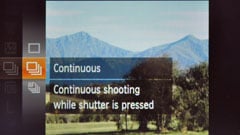 | |
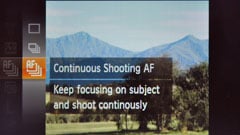
Continuous shot has never been a effective point of most Canon compacts, and sadly the SX210 IS sees nobelium conclude to break the form.
American Samoa much, you birth the pick of two main options delivering either 0.7fps with the centre and exposure locked, operating theatre 0.5fps with autofocus. Yes, that's right, at best you're looking at firing-off a frame all 1.4 seconds with locked focus, or every two seconds with AF. To add abuse to injury, the screen besides blacks-stunned betwixt each frame, qualification it nearly unbearable to follow any natural action.
In insufficient, the continuous shooting capabilities here are fundamentally otiose. As always we gave the camera the do good of the uncertainty, fetching it to take the jet boats on Queenstown's Shotover River, only in typical action sequences we were lucky to fire-slay more than ace frame before the subject was tenacious-gone. Indeed as you hold the shutter release button down, urging the photographic camera to take another shot during each agonising intermission, you wonder if it's even curing to 'burst' at whol. Sadly it is.
Offering some consolation is the Low Light modal value, which fired at just o'er 2fps in our tests – still pretty slacken, but blisteringly quick in compare to the briny modes. The downside to the Low Light mode though is a significantly reduced resolution of 3.5 Megapixels. We've included an example taken with the Depleted Light mode at an airshow, and it was one of the few images we captured which actually had the intended subject in the redact.
At this point it's portentous to compare the SX210 IS against its ii main rivals. Panasonic's TZ10 / ZS7 can shoot at its full resolution at 2.3fps, albeit for only three or five frames depending on the densification. But that's still much Sir Thomas More usable than the SX210 IS. Like the Canon, thither's also a faster option if you're willing to drop the resolution – this time to 3 Megapixels – just at speeds of up to 10fps. Indeed whether shooting at full or reduced solution, the TZ10 / ZS7 is simply often quicker.
 |
|---|
| |
| |
| Support this site by |
Sony's Cyber-shot HX5 is notwithstandin in a completely distinct league, boasting cipher less than a top off speed of 10fps at its full resolution. Information technology may only be able to capture ten frames in a burst and so tie the camera-up for 10-20 seconds piece it records them to the card, just during that legal brief endorsement information technology's equally quick as a pro sports DSLR. So if action photography is your priority, belong for the Sony. The bottom line is if you're into any kind of endless shooting, you will follow disappointed by the Canon SX210 IS.
While the PowerShot SX210 IS is dismal at continuous shooting though, it is kind of good at self-timer photos. Push the rocker downwards lets you choose from button-down ten and cardinal arcsecond countdowns, along with a custom pick which fires-off between extraordinary and ten shots after a delay of 0 to 30 seconds.
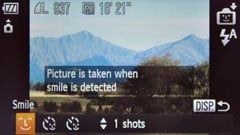
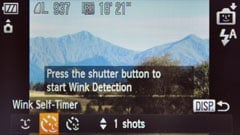
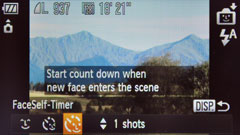
In addition, Canon offers a selection of self-timer options which feat face off signal detection, although bizarrely you won't bump any of them in the self-timer plane section. Instead twis the mode telephone dial to SCN and opt the Smart Shutter option. This gives you the choice of Grin, Wink and Face timers, which delay the countdown until they see the subject either smile or wink or until a new face enters the frame. These sound like a novelty, merely they're actually both sport and useful in practice.
We hardly don't understand why you need to enter a picture preset to access code them, when they really ought to be listed in the normal mortal-timer menu. After all, the 'face-timer' of previous Canon compacts was listed alongside the normal person-timer options, then why IT's moved is a mystery. Sadly without reading the manual (or a elaborate review), more owners may not even realise these options exist.
Canon PowerShot SX210 IS sensing element
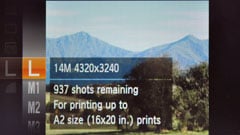
The PowerShot SX210 IS is equipped with a 14.1 Megapixel CCD sensor which measures 1/ 2.3in and delivers 4:3 shaped images with a maximum resolve of 4320×3240 pixels. This gives the SX210 IS the joint highest effective firmness of purpose of its rivals, with the Nikon S8000 matching the pixel count, going Panasonic's TZ10 / ZS7 and Sony's HX5 sounding less thundering with 12.1 and 10.2 Megapixels respectively.
 |
|---|
| |
Spell this bigger number gives Canon and Nikon more to cry approximately in their marketing materials though, a higher result isn't necessarily preferable in practice. Completely four cameras share the same medium-size sensors, so packing more pixels into them runs the risk of exposure of increased noise and reduced energetic range. Feel out our results pages for a direct comparison between the Canyon SX210 IS and the Sony HX5 to see the existent difference betwixt 14.1 and 10.2 Megapixels in terms of tangible-life detail and noise levels. Note, Panasonic's TZ10 / ZS7 actually employs a 14.5 Megapixel sensor, just only uses 12.1 of them in its best-quality images; the 'spare' pixels around the edges are accustomed maintain the angle-of-position and minimize cropping in wider aspect ratios.
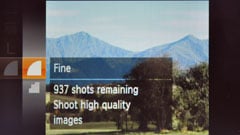
But spine to the Canon SX210 IS which offers four lower resolutions and a cropped 16:9 option, along with the choice of Fine and Normal JPEG compression; unsurprisingly on that point's nary Open choice along this, or the other scoop super-zooms, although we would welcome one if any intersection developers are listening. Best quality Hulking Fine JPEGs measure about 3.7MB each, and like all Canyon compacts, at that place's no more built-in retentiveness to get you started so you'll deman to provide your own plug-in from day-one. As discussed above, the SX210 IS is compatible with SD, SDHC and the latest SDXC cards, with Class 4 or quicker models required to support the HD film mode.
The sensitivity ranges from 80 to 1600 ISO at the grumbling resolution, with the Low Light Aspect Predetermined operating between 400 and 3200 ISO, albeit at a greatly weakened resolution of 3.5 Megapixels. Unlike the Panasonic TZ10 / ZS7, in that location's zero way to adjust the noise reduction.
To encounter how the character of the PowerShot SX210 IS measures-up in practice, take a look at our real-life resolution and gamey ISO noise results pages, shop the sample distribution images gallery, Beaver State skip to the chase and head right for our verdict.
Canon PowerShot SX210 IS
Source: https://www.cameralabs.com/canon_powershot_sx210_is/

Posting Komentar untuk "Canon PowerShot SX210 IS"